Agentic AI — S2 · 1/10: AI biases in regulated environments
AI has no opinion; it has a framing. And yet we want it to carry the absolute truth.
I am opening this season with what I encounter most often, the biases of AI in regulated environments.
Colleagues sometimes use AI to challenge my regulatory analyses. One of them was contested because the AI, when asked, disagreed with me. I put the question to the AI again, without steering it, and got the opposite conclusion.
Two opposite answers, one model, one variable: how the question was framed.
Neither proved anything, neither could settle it.
That is where expertise lies: not in getting the right answer out of the AI, but in knowing the question had to be asked differently.
My analysis did not rest on AI, but on sources, precedents, exchanges with healthcare authorities and notified bodies. The challenge, for its part, rested on authority lent to a tool that has none.
That time, the question was asked again. That is not always the case.
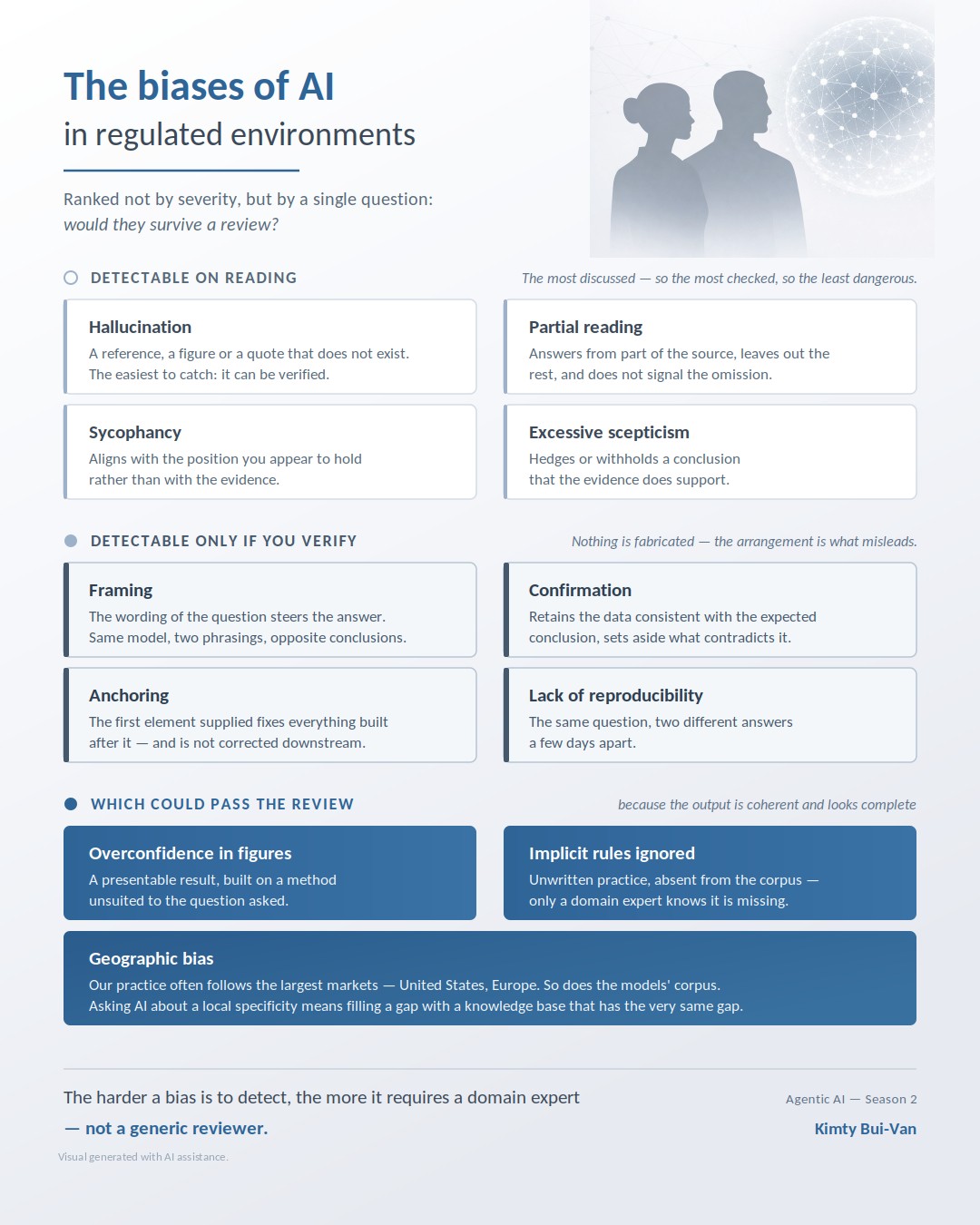
The visual sorts these biases by the only question that matters in our field: would they survive a review?
What you see does not worry me. Hallucination is the most discussed flaw, and the easiest to catch, because a fabricated reference can be verified.
What you do not see begins where nothing is fabricated any more.
Framing, confirmation, anchoring: accurate statements, properly sourced, arranged so that they lead to the wrong conclusion. There is nothing to catch.
In practice, this is what can happen if AI is used to extrapolate shelf life from stability data: the model extends the duration, overlooks variability and the regulatory expectation. The result looks solid.
A visible error costs an hour. A plausible error goes into the dossier.
What concerns me most goes one step further: the biases that pass the review. The unwritten rules no corpus contains. And, across registrations in more than 120 countries, the local specificities absent from the corpus as much as from our own practices.
With agentic AI, the scale changes.
An anchoring bias at step one is not corrected further down: the agent selects the data consistent with it, builds the analysis on that, then proposes an action. Each step is coherent with the one before. It is that coherence that stops anyone from going back to the first.
Judgment remains the final control point. In our professions, it is not the presence of a human that provides safety, but that of an expert able to challenge and to recognise these biases.
Which rule of your profession does no corpus contain?