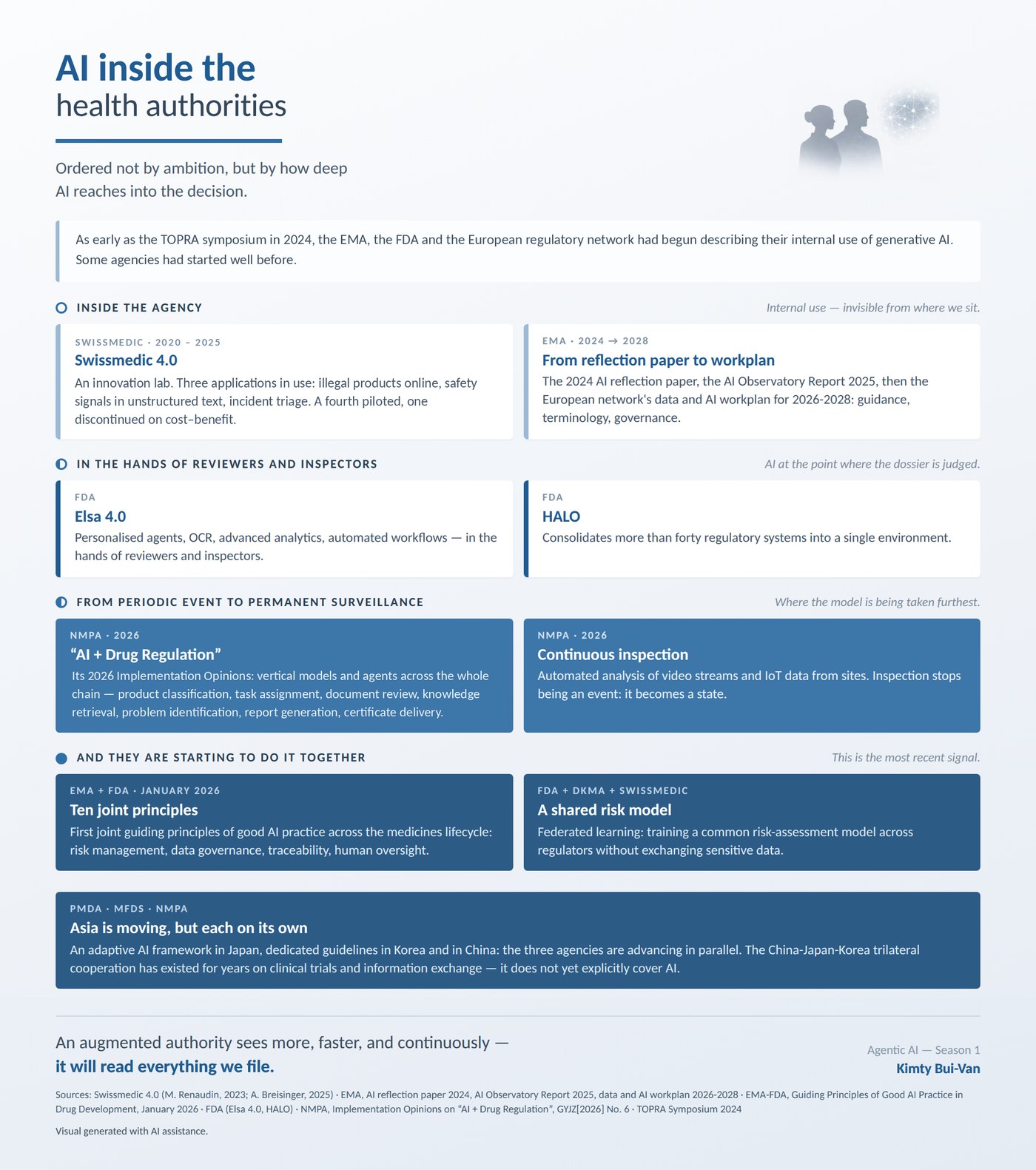
Agentic AI — S1 · 12/12: AI inside the health authorities
For eleven weeks I have been writing about how companies prepare for agentic AI. There is one player I have not written about.
I ran a division at ANSM, the French medicines agency — the one through which the recording and routing of every dossier and every decision passed. When I read what the authorities are deploying today, I can see fairly precisely what it changes on the inside.
As early as the TOPRA symposium in 2024, the EMA, the FDA and the European regulatory network had begun describing their internal use of generative AI. Since then:
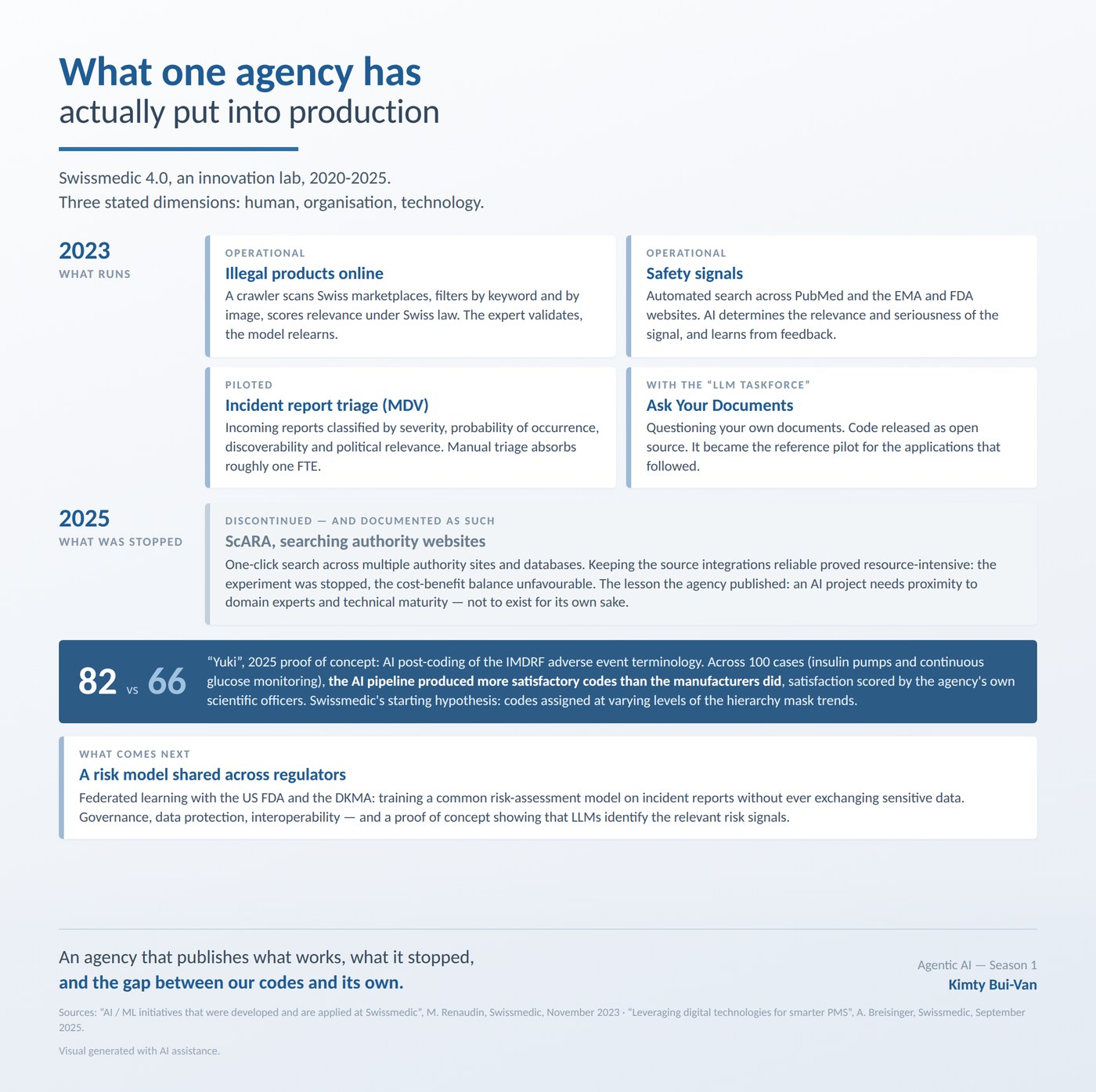
• Swissmedic filters signals and tracks illegal products online.
• The EMA has moved from its reflection paper to a 2026-2028 workplan.
• The FDA has put Elsa 4.0 and HALO in the hands of reviewers and inspectors.
• The NMPA goes furthest, with its 2026 Implementation Opinions. Inspection stops being an event. It becomes permanent.
What lies ahead for the authorities is hard, and I say that without irony.
They have always evaluated deterministic systems. An agentic system rests on confidence thresholds, contextual arbitration, co-produced decisions.
How do you certify a process authored jointly by a human and a machine? Where does responsibility sit when it spreads across whoever designs the agent, whoever supervises it, whoever defines the controls?
The consequence I anticipate is that the authorities will have to use agentic AI themselves in order to regulate agentic AI.
An augmented authority sees more, faster, and continuously. It cross-checks what was not cross-checked, it reads what was not read, it compares a dossier against every dossier that came before it.
Everything I have written about for eleven weeks was therefore not only an efficiency project. It was the condition for remaining legible and compliant in the eyes of a machine that will read everything.
The question “are we ready to use agentic AI?” is already outdated.
It is now a matter of asking whether we are ready to raise our compliance maturity to face authorities augmented by AI.
Has your organisation already asked itself what an augmented authority would see in its dossiers?
Focus: Swissmedic